Bearer Shares Meaning: Definition, Risks, and Why They Are Banned in India
- Share.Market
- 4 min read
- 13 Apr 2026


Highlights
- Understand the meaning of bearer shares and their historical background
- Learn why bearer shares were once widely used but are now restricted or banned in many countries, including India
- Explore the major risks associated with bearer shares, such as loss of certificates, lack of ownership records, and limited investor protection
Introduction
Bearer shares are one of the most intriguing yet controversial forms of share ownership in corporate history. Unlike registered shares, where ownership is officially recorded, bearer shares grant ownership simply to the person holding the physical certificate. This unique structure once made them popular for their privacy, flexibility, and ease of transfer.
However, with the rise of stricter global transparency standards and anti-money laundering regulations, bearer shares have gradually disappeared from most modern financial systems.
This article explores bearer shares in detail, including their historical background, the reasons for their prohibition in India, and the risks they pose to investors and the broader financial system.
What are Bearer Shares? Definition & Mechanism
Bearer shares are equity securities owned by individuals or entities that possess the physical share certificates. These shares are typically issued to an “unnamed bearer,” meaning the shareholder’s identity is not recorded in the company’s register. The company does not track ownership transfers from one holder to another. Holders of bearer shares can transfer them either through exchanges or over-the-counter transactions and are entitled to proprietary and membership rights upon acquiring the shares.
A Brief History of Bearer Shares
The concept of bearer shares originated in the early stages of corporate finance, when ease of transfer and ownership privacy were major priorities. They gained significant popularity during the 19th and early 20th centuries, as they allowed investors to hold and transfer shares discreetly. Over time, however, concerns about their potential misuse led many jurisdictions to impose strict regulations or ban them altogether.
Do Bearer Shares Exist in India?
Although bearer shares offer privacy and easy transferability, they are widely considered risky, especially if the certificates are lost, stolen, or misused. As a result, many countries have either restricted or completely banned their use. Under Indian law, ownership of such shares is not permitted. However, since investors can access international markets, bearer shares may still be available in some European and South American jurisdictions, often with additional compliance requirements and costs.
Like any investment instrument, bearer shares come with both advantages and disadvantages, which investors should carefully evaluate before considering them.
Risks and Limitations of Bearer Shares
As financial regulations have strengthened over time, the drawbacks of bearer shares have become increasingly evident. Although they once provided convenience and privacy, these same features also created significant risks. Understanding these limitations helps explain why bearer shares differ sharply from today’s regulated ownership structures.
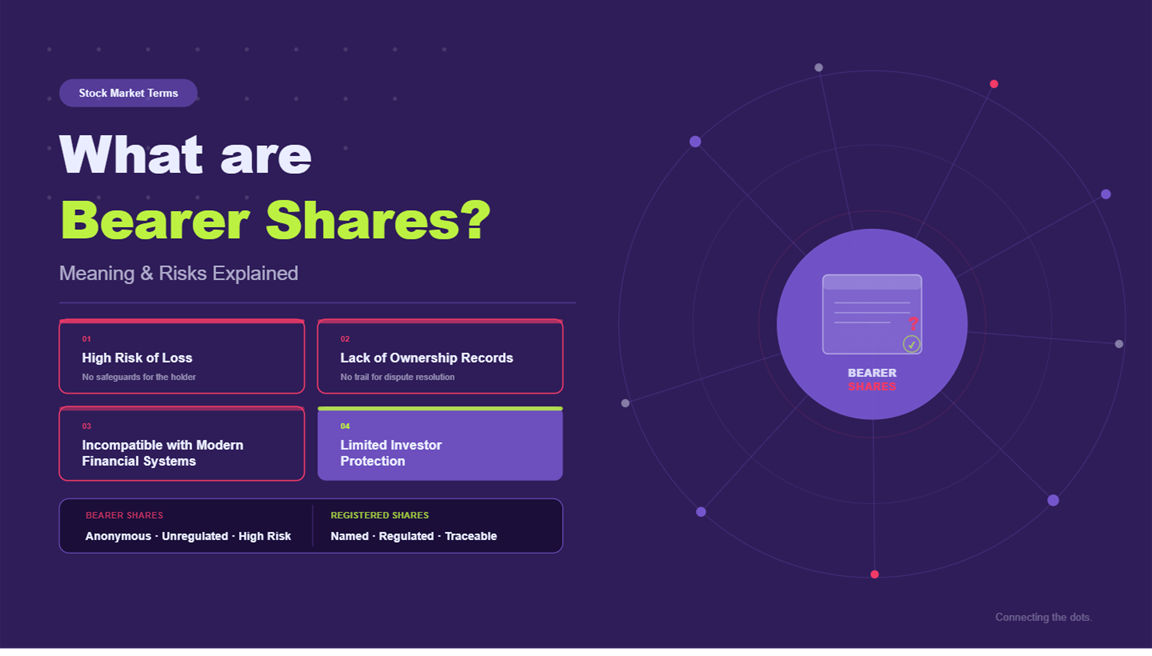
1. High Risk of Loss
Ownership of bearer shares depends entirely on possession of the physical certificate. If the certificate is lost or misplaced, the shareholder may lose all legal rights, since the holder of the certificate is treated as the rightful owner.
2. Lack of Ownership Records for Dispute Resolution
Because there is no official ownership register, resolving disputes related to theft, fraud, or inheritance becomes extremely difficult. The absence of documentation makes legal claims and verification challenging.
3. Incompatibility with Modern Financial Systems
Most global financial markets no longer recognise bearer shares due to strict transparency and compliance requirements. As a result, they are largely unsuitable for participation in regulated exchanges and structured investment environments.
4. Limited Investor Protection
Since bearer shares are not recorded in official systems, investors may not benefit from key safeguards such as verified dividend payments, proxy-based voting rights, and legal protections available under securities regulations.
The Global Shift Toward Transparency
Bearer shares, once appreciated for their anonymity and ease of transfer, are now largely considered outdated due to increasing legal and regulatory concerns. In India, such shares are explicitly prohibited under company law and SEBI regulations. Today, stronger regulatory standards have replaced them with more secure and traceable ownership structures, making them largely unsuitable for investors in regulated markets.
FAQs
No, India banned bearer shares in 2013 through the Companies Act.
Bearer shares enable money laundering and tax evasion through untraceable ownership. They’re vulnerable to theft or loss without recovery mechanisms and face regulatory restrictions in most jurisdictions, including India.
Technically, yes, in countries that still allow them. But Indian investors face strict reporting rules, tax issues, and the risk of international sanctions. It is generally not recommended without expert legal advice.
Ownership is not recorded in bearer shares, whereas it is formally documented in common shares.