What is IOC in Trading? Full Form & How it Works
- Share.Market
- 6 min read
- 19 Mar 2026


Highlights
- IOC stands for Immediate or Cancel, a duration-based order designed for immediate execution if matching orders are available.
- Any portion of the order that cannot be filled the moment it reaches the exchange is automatically cancelled.
- It prevents orders from remaining in the order book, which may help reduce exposure to sudden price movements.
- Commonly used in high-volatility scenarios such as F&O trading or news-driven market conditions.
Introduction
In trading, opportunity can appear and disappear faster than a trending meme.
For active traders, the ability to control how long an order remains active is a crucial part of risk management. While most investors are familiar with buying and selling, the way you place an order can be just as important as the price itself. One of the tools used by traders for more controlled order execution is the IOC order.
Unlike a standard limit order that might sit in the order book for hours, an IOC order attempts immediate execution when the order reaches the exchange. It is designed for the trader who prefers immediate execution rather than waiting in the order book.
What is IOC in the Share Market?
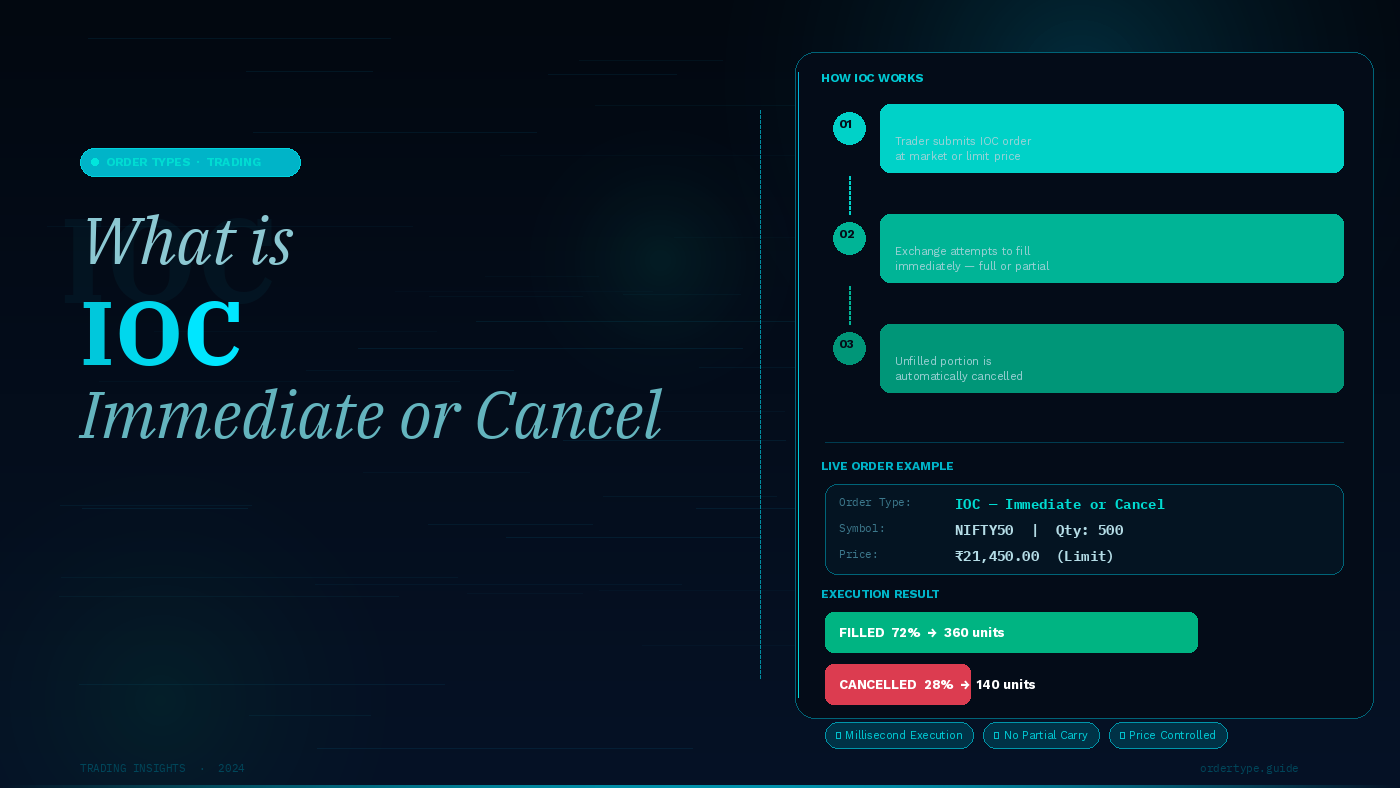
The full form of IOC is Immediate or Cancel. It is a duration-based instruction that tells the trading system to execute the order as soon as it reaches the exchange. If the order cannot be fulfilled immediately—whether due to lack of liquidity or a price mismatch—the system cancels it automatically.
Understanding what an IOC is helps DIY investors solve the “stale order” problem. In a volatile market, a price that looks attractive at 10:00 am might become a losing position by 10:05 am. By using an IOC instruction, you ensure that if the trade doesn’t happen now, it doesn’t happen at all, and it helps reduce the risk of orders executing later during unfavourable price movements.
How the IOC Mechanism Works
The Immediate or Cancel instruction focuses on the “validity” of the order. It follows an immediate execution approach, allowing partial fills and cancelling the remaining quantity. Here is a breakdown of how it functions in a real-world trading scenario:
- Placement: You place an order to buy 1,000 shares of a stock with an IOC tag.
- Matching: The exchange instantly looks for available sellers at your specified price.
- Execution or Cancellation:
- Full Execution: If 1,000 shares are available, the trade is completed.
- Partial Execution: If only 400 shares are available, you buy those 400, and the remaining 600 are cancelled.
- Zero Execution: If no shares are available at your price, the entire order is cancelled instantly.
This automated “housekeeping” helps avoid leaving pending orders in the order book.
IOC Vs. Other Order Types
To choose the right order type based on your trading objective, you must choose the right tool for the right goal. Here is how IOC compares to other common validity instructions:
| Order Type | Duration | Outcome if not filled |
| IOC (Immediate or Cancel) | Instantaneous | Cancelled immediately |
| Day Order | Until 3:30 pm | Remains in the book until the end of the session |
| GTT (Good Till Triggered) | Up to a year | Stays active until your price trigger is hit |
While a Day Order is suitable for long-term investors who are comfortable waiting for a price, the IOC is commonly used by active traders who prioritise execution speed and order control.
Strategic Advantages of Using IOC
Why would a trader use an order that might result in a cancellation? The answer lies in execution control and risk management. IOC orders help traders attempt immediate execution and avoid leaving pending orders in fast-moving markets.
1. Navigating High Volatility
During events like earnings calls or policy announcements, price gaps can occur in seconds. An IOC order reduces the chance of orders remaining pending and getting filled later at unfavourable prices.
2. Managing Liquidity and “Slippage”
When trading large volumes, you might not find enough sellers at a single price. IOC allows the execution of available quantities at the specified price at that moment. By cancelling the unfilled portion, it prevents you from buying the rest at a much higher price (slippage).
3. Freedom of Capital
Because an IOC order doesn’t “rest” in the system, your margins and funds are typically released soon after the order is executed or cancelled, depending on broker systems. This allows you to quickly pivot to a different stock or strategy without manually managing your order book.
When Should You Use IOC?
- Scalping and Intraday Trading: Where seconds matter, and small price movements define profit or loss.
- F&O Trading: In the Futures & Options segment, where premiums change rapidly, execution speed is often an important factor.
- Large Block Trades: When you want to check the market’s depth without leaving large visible orders in the order book for extended periods.
Empowerment Through Precision
Taking ownership of your investment journey means mastering the mechanics of the exchange. The Immediate or Cancel order is more than a technical setting; it is a tool for disciplined execution. It allows you to move from instinct to informed action, ensuring that your trades reflect your current strategy, not an outdated one from an hour ago.
By removing the uncertainty of pending orders, you can trade with greater clarity on how your orders are executed.
Master Your Execution
Using intelligence-driven tools like IOC orders allows you to navigate the share market with surgical precision. Whether you are executing a complex F&O strategy or building a long-term portfolio, knowing how to control your order duration gives you better control over order execution in fast-moving markets.
FAQs
The full form of IOC is Immediate or Cancel. It is an order that must be executed immediately if matching orders are available; otherwise, it is cancelled.
Yes. If only a portion of your order quantity is available at your price, that portion will be traded, and the rest will be cancelled.
Yes, the IOC instruction can be applied to both buy and sell orders across equity and derivative segments.
An IOC order allows for partial fills (buying whatever is available), whereas a Fill or Kill (FOK) order requires the entire quantity to be filled immediately, or the whole order is cancelled.
No, brokers do not charge extra for selecting IOC. You only pay standard brokerage on the portion of the order that actually executes.
No. Since the execution or cancellation happens the moment the order reaches the exchange, there is no time to modify it.