

Indian Market In March: US-Iran War, LPG, Gold and Silver, India-US Deal & More
- Share.Market
- 6 min read
- 02 Apr 2026


The West Asia War set the tone for Indian markets in March, leading to a decline in Nifty 50, Sensex and most sectoral indices.
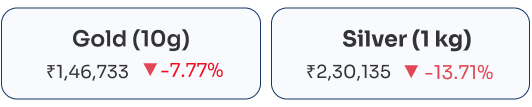
Gold and Silver pared gains, the Rupee hit a record low against the US Dollar, and Foreign Institutional Investors (FIIs) continued to pull out money from emerging markets like India. Continued tensions in the Strait of Hormuz led to a surge in global freight costs.


Sector Radar


All sectors were in the red. Nifty PSU Bank, Bank Nifty, and Nifty Realty were among the top losers this month, while Nifty IT, Nifty Healthcare and Nifty Pharma remained relatively stable.
- Banks bore the brunt of the sell-off due to extreme sensitivity to surging government bond yields.
- The realty sector was affected by rising input costs (driven by elevated crude oil prices).
- IT was pressured by global tech valuation cooling, but remained resilient as the depreciation of the Rupee acted as a hedge, boosting the value of its dollar-denominated export earnings.
- The Healthcare and Pharma sectors functioned as defensive safe havens.
Precious Metals

Corporate Moves
 BHEL
BHELBHEL secured a ₹13,500 crore order from NTPC for the main plant package of the 2,400 MW Telangana Stage-II thermal power plant.
 COALINDIA
Coal India’s subsidiary, Central Mine Planning & Design Institute, got listed at a 7% discount, reflecting weak investor sentiment.
 RELIANCE
Reliance denied media reports of purchasing Iranian crude oil, calling them false and misleading.
 MARUTI
Maruti Suzuki will be investing ₹10,189 crore in Khoraj, Gujarat, for a car manufacturing plant with a capacity of 2.5 lakh cars per annum. The company’s existing total capacity is 24 lakh cars per annum.
 HDFCBANK
Part-time Chairman and Independent Director Atanu Chakraborty resigned with immediate effect on 18 March. The RBI approved Keki Mistry as interim part-time Chairman for 3 months, effective 19 March.
 IRFC
IRFCIRFC signed a ₹12,842 crore loan agreement to refinance Hindustan Urvarak and Rasayan Ltd’s debt.
 HINDUNILVR
Hindustan Unilever clarified that it is not considering any divestment of its foods business.
 TATASTEEL
Tata Steel approved merging Neelachal Ispat Nigam with itself, investing up to ₹18,488 crore in its overseas subsidiary ‘T Steel Holdings Pte Ltd’.
Market Spotlight
- India and Canada signed agreements to bolster cooperation in critical minerals and nuclear and solar energy.
- India and Finland signed MoUs on migration and mobility, environmental cooperation, and statistics. The two countries also agreed to expand collaboration in trade and technology.
- The signing of the India-US trade deal will be put on hold until a new tariff structure between the two countries is finalised.
- Crude oil touched a high of $119.50 per barrel on March 09, 2026
- Towards the end of March, US President Donald Trump said the US is in talks with a “more reasonable regime” in Iran but warned of major strikes if the Strait of Hormuz is not reopened.
Macro View
- RBI directed banks to cap their net open rupee positions in the foreign exchange market at $100 million by the end of each business day by April 10, leading to a sharp fall in Bank Nifty.
- India’s fiscal deficit reached 80.40% of the FY26 target at ₹12.53 lakh crore by February, lower than last year’s ₹13.46 lakh crore for the same period.
- S&P Global raised India’s FY27 growth forecast by 40 bps to 7.1%, driven by resilient consumption, improving private investment, and steady exports.
- The Indian Rupee touched an all-time low of 95.22 against the US Dollar on March 30, 2026.
- The government has invoked the Essential Commodities Act, 1955 to prioritise LPG production and supply amid shortages due to the war in West Asia. Refiners have been directed to maximise LPG output for household use and prevent diversion of key petroleum streams to other products.
Financial Changes from April 2026
- India officially sunset the 1961 Income Tax Act, migrating to the Income Tax Act 2025.
- Previous year and assessment year were replaced with Tax year.
- Form 16 has been replaced by Form 130 for salary reporting.
- Bengaluru, Hyderabad, Pune, and Ahmedabad have been classified as metro cities.
- Instead of bundling all costs, fund houses must now disclose statutory levies (GST and STT) separately from the base management fee.
- The Securities Transaction Tax (STT) on derivatives has been increased to manage speculative volatility.
That’s a wrap for February!
From sector moves to macro trends and market risks, we’ve covered what mattered.
See you next month. Till then, stay informed and invest intelligently with Share.Market.


