
Futures Vs. Options: Key Differences, Tax & Which Is Better
- Share.Market
- 5 min read
- 20 Mar 2026


Highlights
- Understand how futures create binding obligations while options provide rights without obligations under SEBI regulations.
- Discover tax treatment under Section 43(5), classifying F&O as non-speculative business income.
- Compare risk profiles, margin requirements, and suitability to decide which derivative matches your capital and strategy.
Introduction
When markets turn volatile, futures and options become the buzzwords everyone wants to act on. Yet, according to the latest study by the Securities and Exchange Board of India, 93% of retail traders lost money in F&O trading between FY22 and FY24. The excitement is real, but so is the risk.
Before stepping into derivatives, investors need to understand one crucial distinction. The difference between futures and options is not technical jargon. It directly shapes your risk exposure, capital commitment, and potential losses. Both are governed under the Securities Contracts Regulation Act and derive their value from underlying assets. But one binds you to an obligation, while the other gives you the right to walk away.
That single difference can decide whether you manage risk wisely or become part of the losing majority.
What are Futures and Options?
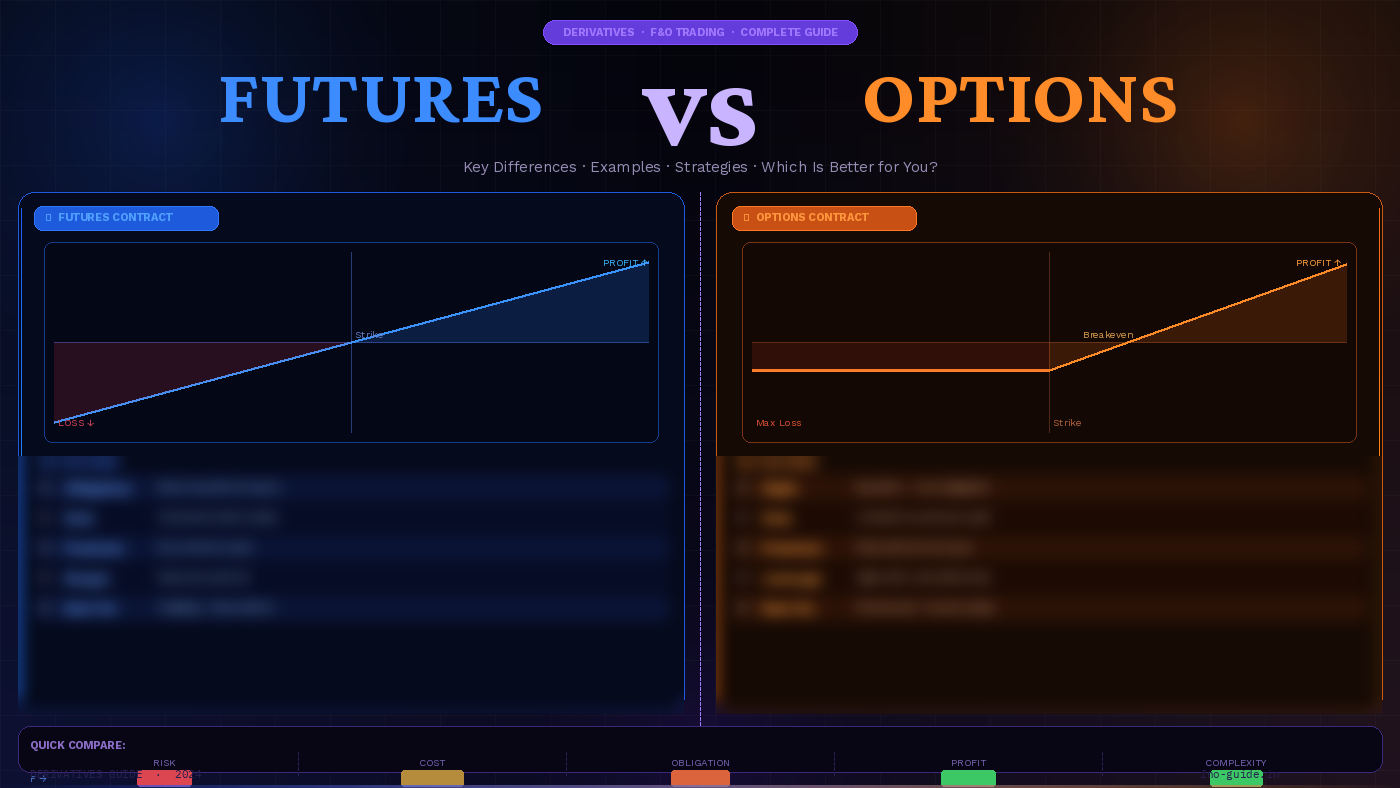
Futures contracts are legally binding agreements where both parties must buy or sell the underlying security at a specified future date, as defined by SEBI. When you buy NIFTY futures, you’re obligated to settle at expiry, even if the market moves for or against you.
Options contracts give the buyer the right but not the obligation to buy or sell at a predetermined price within a specified time, according to SEBI regulations. You pay a premium for this flexibility.
Key Differences Between Futures and Options
| Aspect | Futures | Options |
| Obligation | Both parties must execute at expiry | Buyer has the right; seller has the obligation |
| Risk | Unlimited for both buyer and seller | Buyer: Limited to premium; Seller: Unlimited |
| Premium | No upfront premium | Buyer pays a premium for the right |
| Settlement | Daily mark-to-market | At expiry or when exercised |
| Margin | Higher initial margin (10-15%) | Lower for buyers; higher for sellers |
Tax Treatment of F&O in India
Both futures and options are classified as non-speculative business income under Section 43(5) of the Income Tax Act, not capital gains. This changes everything about tax planning.
What this means:
- Profits taxed at your income tax slab rate
- Losses can be set off against other business income
- Losses carried forward for 8 years
- Tax audit mandatory if turnover exceeds ₹10 crore (with exceptions)
If you’re in the 30% tax bracket, your F&O profits get taxed at 30%, which is significantly higher than equity capital gains.
Who Should Trade Futures and Options?
Here’s the uncomfortable truth: SEBI’s study shows over 1 crore individual traders lost an average of ₹2 lakh each during FY22-24, with aggregate losses exceeding ₹1.8 lakh crore.
Institutional traders using algorithms captured 97% of FPI profits and 96% of proprietary trader profits.
F&O may suit you if:
- You understand derivatives thoroughly
- You use them for hedging existing positions, not speculation
- You have time for active position management
Avoid if:
- F&O represents your first investment experience
- You’re seeking “quick returns”
- Capital loss would affect financial stability
Which Is Better for You?
Choose futures if: You want to hedge large equity positions and can handle unlimited risk exposure. The obligation structure suits experienced traders with strong conviction on market direction.
Choose options if: You prefer defined risk or want to generate premium income. Options provide flexibility, but complexity increases with strategies like spreads and straddles.
For most retail investors: Neither may be appropriate. SEBI data suggests focusing on spot equity or mutual funds until you’ve built substantial capital and expertise.
The Reality Behind Derivatives Trading
Derivatives often look like fast-track vehicles to outsized gains. The data tells a different story. A recent study by the Securities and Exchange Board of India shows that the overwhelming majority of retail traders in futures and options end up losing money. That is not a coincidence. It reflects the complexity, leverage, and speed at which losses can compound.
Futures and options are not designed as beginner-friendly wealth builders. They demand disciplined risk management, adequate capital buffers, and a clear understanding of how leverage magnifies both profits and losses. A futures contract creates a binding obligation. An option gives you the right, but at a cost. Misunderstand either, and the market will quickly remind you.
Before stepping into F&O, understand how speculative transactions are treated under Section 43(5) of the Income Tax Act, calculate whether you can comfortably meet margin requirements, and assess whether you can withstand sharp drawdowns without emotional decisions.
The 7% who profit in F&O are typically well-capitalised, professionally trained, and systematic in their approach. The real question is not whether F&O can generate returns. It is whether you have the capital, knowledge, and temperament to operate in that league.
FAQs
Futures create obligations for both parties to execute at expiry. Options give buyers rights without obligation, while sellers face an obligation if the buyer exercises. Buyers pay a premium for this flexibility.
Both are classified as non-speculative business income under Section 43(5). Taxed at slab rates. Must file ITR-3. Losses carried forward 8 years against business income.
NSE requires index contracts worth ₹15-20 lakh. With typical 10-15% margins, the minimum capital needed is ₹2-3 lakh, though this varies by contract and market volatility.
SEBI data shows 93% of retail traders lost an average of ₹2 lakh during FY22-24. Only 7% profitable. Institutional algo traders captured 96-97% of profits, making it extremely difficult for individuals.
Futures carry unlimited risk for both parties as the obligation must be fulfilled. Options limit buyer risk to the premium paid, but sellers face unlimited risk. Options are generally safer for beginners as buyers.



