

Nifty 50 Stocks’ Weightages Changed: How Will This Affect Your Mutual Funds?
- Share.Market
- 3 min read
- Published at : 09 Jun 2026 12:26 PM
- Modified at : 09 Jun 2026 05:40 PM


A major shift has occurred within India’s capital markets. Reliance Industries, the country’s largest corporation by total market capitalization, has slipped to the third position in terms of weightage in the benchmark Nifty 50 index.
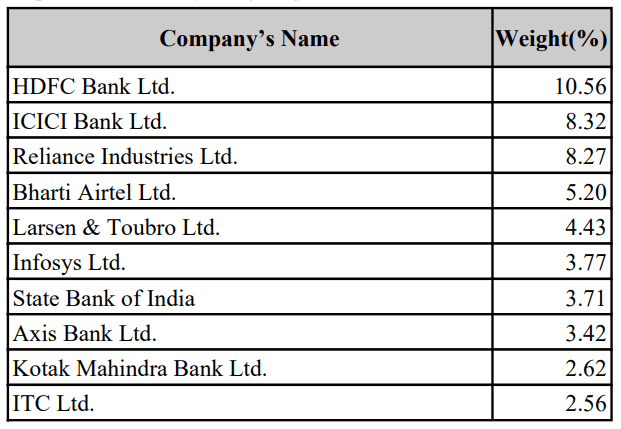
Stepping into the second-place spot is the private sector banking powerhouse, ICICI Bank , while HDFC Bank continues to command the top spot as the single largest constituent with a dominant 10.56% weightage.
Reliance Industries commands a total market capitalization nearly double that of ICICI Bank, yet ICICI Bank exerts a greater influence over the movement of the Nifty 50 Index. This boils down to the difference between free float and total market capitalization, and the mechanics of index construction.
Although Reliance Industries commands the highest overall market capitalisation of ₹17.18 lakh crore on the NSE, its free-float market capitalisation stands at a little over ₹8.52 lakh crore. As a result, the company currently holds an 8.27% weight in the Nifty 50 index.
In comparison, ICICI Bank has a total market capitalisation of more than ₹9.09 lakh crore, while its free-float market capitalisation stands at ₹9.05 lakh crore on the NSE, which is higher than Reliance Industries’ free-float. This has enabled ICICI Bank to emerge as the second-largest stock by weightage in the Nifty 50 index, as the weightage of stocks in Nifty 50 is calculated by the free float market capitalization methodology.
Weightage can also impact mutual funds and ETFs. Read on to know more.
Nifty 50’s Top Constituents By Weightage

What Is Weightage? Why Is It Important?
Think of an index (like the Nifty 50 or S&P 500) as a parliament. A stock’s weightage is the number of seats it holds. When a company’s weight increases or decreases, its power to dictate the direction of the market changes.
The higher a stock’s weight, the more sensitive the headline index is to that company’s health. For example, if a stock with a 10% weight drops by 5% in a day, it drags the index down with it. However, if a stock with a 0.2% weight falls by 5%, there might be a negligible impact on the index.
Full Market Capitalisation vs Free-Float Market Capitalisation
Full market capitalisation represents the total value of all outstanding shares of a company, including promoter holdings, government stakes, and shares held by strategic investors that are typically not actively traded in the market.
On the other hand, free-float market capitalisation reflects the total value of shares that are freely available for trading in the open market. It excludes promoter holdings and other locked-in shares.
Free-float market capitalisation is generally lower than a company’s total market value, and is widely used by major indices, including those by NSE, BSE, MSCI, and S&P to determine constituent weightages more accurately.
What Could The Second-Order Effects Be?
Just two private banks HDFC Bank (with 10.56% weightage) and ICICI Bank (with 8.32% weightage) occupy the top two slots and dictate nearly 20% of Nifty 50 — India’s flagship index. A bad quarter for private banking could drag down the index, even if the rest of the sectors might be doing relatively well.
Passive index funds and ETFs that track the Nifty 50 will be forced to automatically buy more of ICICI Bank to track the index, increasing inflow.


